
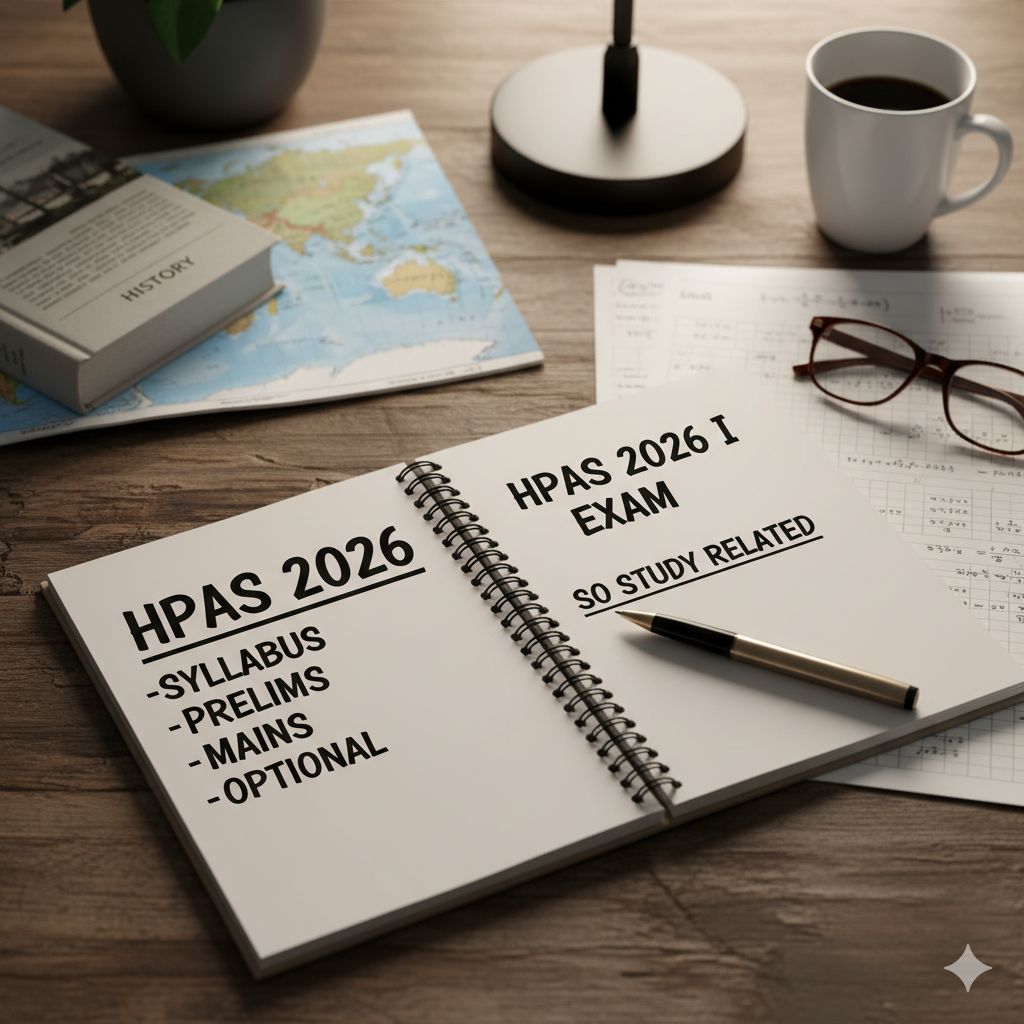
HPAS 2026: Syllabus & Paper Pattern
A complete guide to the HPPSC HPAS 2026 Examination.
📝 Introduction
Welcome to the complete guide on HPAS 2026 Syllabus and Paper Pattern, based on the latest official notification by the Himachal Pradesh Public Service Commission (HPPSC). This page provides a detailed breakdown of the HPAS 2026 Prelims and Mains exam structure, marking scheme, subjects, and qualifying criteria.
📌 Explore more HPAS 2026 resources:
- 🔍 HPAS 2026 Prelims Previous Year Questions (PYQ) – Click here
- 📚 HPAS 2026 Mains Previous Year Questions (PYQ) – Click here
- 📑 Download Official HPPSC HPAS 2025 Notifications – Click here
📄 Table of Contents
- HPPSC HPAS 2026 Exam Pattern
- HPPSC HPAS 2026 Prelims Syllabus
- HPPSC HPAS 2026 Mains Exam Pattern
- HPAS 2026 Paper I: English Syllabus (100 Marks)
- HPAS 2026 Paper II: Hindi Syllabus (100 Marks)
- HPAS 2026 Paper III: Essay Syllabus (100 Marks)
- HPAS 2026 Paper IV: General Studies‑I Syllabus (200 Marks)
- HPAS 2026 Paper V: General Studies‑II Syllabus (200 Marks)
- HPAS 2026 Paper VI: General Studies‑III Syllabus (200 Marks)
- HPAS 2026 Optional Subjects (Papers VII & VIII)
- HPAS 2026 Interview (Viva Voce) Guidelines
🏛️ HPPSC HPAS 2026 Exam Pattern
✅ Total Marks for Merit: 1050
Stages of Examination:
- Preliminary Examination (400 marks – qualifying only)
- Main Examination (900 marks – counted for merit)
- Viva Voce (Interview) (150 marks – counted for merit)
📘 Stage 1: HPAS 2026 Prelims Examination (Screening Test)
| Paper | Subject | Marks | Questions | Duration |
|---|---|---|---|---|
| Paper I | General Studies | 200 | 100 | 2 Hours |
| Paper II | General Studies (Aptitude Test) | 200 | 100 | 2 Hours |
📝 Key Points (Prelims):
- Total Marks: 400
- Type: Objective (MCQs)
- Negative Marking: Yes – 1/3rd mark deducted for each incorrect answer
- Paper II (Aptitude Test): Qualifying in nature – Minimum 33% required
- Purpose: Screening only – Marks NOT counted for final merit list
📚 Stage 2: HPAS 2026 Mains Examination
| Paper | Type | Subject | Marks | Duration |
|---|---|---|---|---|
| Paper I | Qualifying | English | 100 | 3 Hours |
| Paper II | Qualifying | Hindi (Devanagari script) | 100 | 3 Hours |
| Paper III | Merit | Essay | 100 | 3 Hours |
| Paper IV | Merit | General Studies-I | 200 | 3 Hours |
| Paper V | Merit | General Studies-II | 200 | 3 Hours |
| Paper VI | Merit | General Studies-III | 200 | 3 Hours |
| Paper VII | Merit | Optional Subject Paper-I | 100 | 3 Hours |
| Paper VIII | Merit | Optional Subject Paper-II | 100 | 3 Hours |
🟩 Total for Merit: 900 Marks
(Papers III to VIII only)
🟨 Qualifying Papers: English & Hindi
(Minimum 40% each required)
🟥 Aggregate Criteria: 45%
(In total of merit papers)
🎤 Stage 3: Viva Voce (Interview)
- Marks: 150
- Candidates: Only those who qualify the written stage (mains)
📊 Final Merit Calculation = 900 (Mains) + 150 (Interview) = 1050 Marks
📝 HPPSC HPAS 2026 Prelims Syllabus
🔹 Paper – I: General Studies (Code No.01)
Total Marks: 200 | No. of Questions: 100 | Type: Objective (MCQ)
📚 Syllabus Topics:
-
Himachal Pradesh Focus:
- History of Himachal Pradesh
- Geography of Himachal Pradesh
- Art & Culture of Himachal Pradesh
- Political aspects of Himachal Pradesh
- Socio-Economic Development of Himachal Pradesh
-
India & World:
- Current Events of National and International Importance
- History of India & Indian National Movement
- Indian and World Geography – Physical, Social, and Economic Geography
- Indian Polity and Governance (Constitution, Political System, Panchayati Raj, Public Policy, Rights Issues)
-
Development & Environment:
- Economic and Social Development (Sustainable Development, Poverty, Inclusion, Demographics, Social Sector Initiatives)
- General Issues on Environmental Ecology, Biodiversity, and Climate Change
- General Science
🔹 Paper – II: Aptitude Test (Code No.02)
Total Marks: 200 | No. of Questions: 100 | Type: Objective (MCQ)
🟨 Qualifying Nature: Minimum 33% required
🧠 Syllabus Topics:
- Comprehension
- Interpersonal Skills Including Communication Skills
- Logical Reasoning and Analytical Ability
- Decision Making and Problem Solving
- General Mental Ability
- Basic Numeracy (Class X level)
- Data Interpretation (Class X level)
- English Language Comprehension Skills (Class X level)
📝 HPPSC HPAS 2026 Mains Exam Pattern
| Paper | Subject | Maximum Marks |
|---|---|---|
| Paper I | English | 100 |
| Paper II | Hindi | 100 |
| Paper III | Essay | 100 |
| Paper IV | General Studies-I | 200 |
| Paper V | General Studies-II | 200 |
| Paper VI | General Studies-III | 200 |
| Paper VII | Optional Paper I | 100 |
| Paper VIII | Optional Paper II | 100 |
✅ HPAS 2026/HAS 2026 Mains Exam – Paper Pattern & Marks Distribution
📌 Qualifying Papers (Marks not counted for merit)
These two papers are compulsory but only qualifying in nature:
| Paper | Subject | Marks | Qualifying Criteria |
|---|---|---|---|
| I | English | 100 | Minimum 40% |
| II | Hindi (in Devanagari script) | 100 | Minimum 40% |
📌 Merit-Based Papers (Total = 900 marks)
| Paper | Subject | Marks |
|---|---|---|
| III | Essay | 100 |
| IV | General Studies – I | 200 |
| V | General Studies – II | 200 |
| VI | General Studies – III | 200 |
| VII | Optional Subject – Paper I | 100 |
| VIII | Optional Subject – Paper II | 100 |
🔢 Total for merit (HPPSC HPAS 2026): 900 Marks
📝 Qualifying Criteria Summary (HPAS 2026 Mains)
- ✅ 40% minimum in each qualifying paper (English & Hindi).
- ✅ 45% aggregate in all merit-based papers (i.e., 405 marks out of 900) to qualify the written examination.
📘 HPAS 2026 PAPER–I: ENGLISH (100 MARKS)
🔹 Nature: Qualifying Paper
🔹 Minimum Qualifying Marks: 40% (i.e., 40 marks)
🔹 Marks not counted in final merit
🎯 Objectives
To assess candidate’s aptitude in:
- Comprehension of the English language
- Correct grammatical expression
- Clarity and precision in expression
📝 Areas of Testing
| Section | Marks |
|---|---|
| English Grammar | 20 |
| Usage and Vocabulary | 20 |
| English Composition (Letter/Application/Report/Note Writing) | 20 |
| Comprehension of Unseen Passages | 20 |
| Precis Writing | 20 |
📊 Evaluation / Marking Criteria
Credit will be given for:
- Précis writing, comprehension, and composition as per prescribed format
- Coherence and logical sequence in expression
- Correct grammatical structures
- Originality of thought and expression
📝 HPAS 2026 PAPER–II: HINDI IN DEVNAGARI SCRIPT (100 MARKS)
🔹 Nature: Qualifying Paper
🔹 Minimum Qualifying Marks: 40% (i.e., 40 marks)
🔹 Marks not counted in final merit
📚 Contents
- Translation of an English passage into Hindi
- Translation of a Hindi passage into English
- Explanation of Hindi passages in Prose and Poetry (in the same language)
- Composition (Idioms, corrections, etc.)
📊 Evaluation / Marking Criteria
- Accuracy and clarity in translation (both directions)
- Understanding and explanation of the Hindi passages
- Proper usage of:
- Idioms
- Grammatical corrections
- Language structure in composition
📝 HPAS 2026 PAPER–III: ESSAY (100 MARKS)
🔹 Nature: Merit Paper
🔹 Counts towards final merit (900 marks total)
🎯 Objective
This paper is designed to assess the candidate’s:
- Knowledge and awareness of a variety of subjects
- Ability to compose a sustained and coherent piece of writing in the form of an essay
📚 Contents
Candidates will be given a fair choice of topics that cover the following areas:
- Current Affairs
- Socio-Political Issues
- Socio-Economic Issues
- Aspects of Culture and History
- Reflective Topics
🖊️ Candidates are required to attempt two essays (one from Section A and one from Section B), each of approximately 900 words.
🧠 Areas of Testing
- Ability to compose a well-argued piece of writing
- Ability to express thoughts coherently and in a structured manner
- Awareness and depth of understanding of the subject chosen
📊 Evaluation / Marking
Candidates will be evaluated based on:
- Observing established rules and format for essay writing
- Grammatical correctness
- Originality of thought and expression
📘 HPAS 2026 PAPER–IV: GENERAL STUDIES–I (200 MARKS)
🔹 Merit Paper (Included in the 900 Marks total)
🔹 Divided into 3 Units
🔸 UNIT–I: HISTORY & CULTURE
SUB UNIT–1: Historical Perspective of Indian Cultural Heritage
- Literature and Art forms from ancient times to 1947
- Major structural and rock-cut temple architecture, sculptural art, and major schools of paintings
- Modern Indian History from Mid-18th Century to 1980
- Freedom Struggle: Its various stages and the role of eminent personalities
SUB UNIT–2: Industrialization and Global Events
- Industrial Revolution and the emergence of Capitalism
- Fascist Ideology and its global implications
- World Wars and boundary settlements
- Concept of Decolonization, Nationalism, Socialism, Globalization, and Modernity
SUB UNIT–3: Political and Social History of Himachal Pradesh
- Emergence and growth of early medieval states: Kangra, Kullu, and Chamba
- Hill States and their relations with the Mughals and the Sikhs
- Gorkha Invasion, Treaty of Segauli
- Hill States under the Colonial Power: Political and Administrative History
- Social and Economic conditions (Beth, Begar, and Reet)
- Establishment of British Cantonments
- National Movement with special reference to Praja Mandal movements (1848–1948)
- Five Year Plans and vision for the developed Hill State
- Survey of artistic and cultural heritage (Temples, Monasteries, Paintings)
📌 All topics under SUB UNIT-3 are relevant to Himachal Pradesh.
🔸 UNIT–II: GEOGRAPHY & DISASTER MANAGEMENT
SUB UNIT–1: Disaster Management
- Introduction to Disasters: Concepts, classifications (natural and man-made)
- Social and Environmental impacts
- Disaster profile of the country
- Approaches to Disaster Risk Reduction
- Disaster management models and roles of stakeholders
- Interrelationship of disaster and development
- Disaster management in India: Act 2005, policies, plans
SUB UNIT–2: Physical Geography of India
- Geographical Introduction to India
- Physical Geography: Structure, Relief, Climate, Soils, Vegetation, Geomorphic setup
- Human Aspects: Population distribution, Urban Population, Internal Migration
- Language and Literacy, Villages and Towns
- Settlements, Industry, and Transport
SUB UNIT–3: Geography of Himachal Pradesh
- Relief, Drainage, Vegetation cover and types
- Climate and Climatic zones
- Geographical Regions (Shiwalik, Doons, Mid Hills, High hills, etc.)
- Human Aspects: Population characteristics, Urbanisation pattern
- Policies: Forest, Industrial, and Tourism
- Growth of Industrial areas and types of industries
- Employment generation and potential
- Hazard Vulnerability and Risk Profile of Himachal Pradesh
📌 All topics under SUB UNIT-3 are relevant to Himachal Pradesh.
🔸 UNIT–III: INDIAN SOCIETY & HIMACHAL CULTURE
SUB UNIT–1: Social Issues in India
- Salient features of Indian Society: Unity in Diversity
- Social Institutions: Family, Marriage, Kinship, Religion
- Women Empowerment and Social Justice
- Child Rights and Right to Education
- Rights of Differently-abled persons
SUB UNIT–2: Core Values in Public Service and Governance
- Philosophical basis: Integrity, Professionalism, Accountability
- Objectivity and Transparency, Right to Information
- Codes of Conduct, Work Culture
- Challenges of Corruption and Political Pressures
- Gandhian Thought: Truth and Non-violence, Satyagraha, Religion and Politics
SUB UNIT–3: Society and Culture in Himachal Pradesh
- Culture, Customs, Fairs and Festivals
- Religious Beliefs and Practices
- Tribes of Himachal Pradesh: Historical, Social, Cultural, Economic aspects
- Family, Marriage, Kinship, and Caste System in Himachal Pradesh
📌 All topics under SUB UNIT-3 are relevant to Himachal Pradesh.
📘 HPAS 2026 PAPER–V: GENERAL STUDIES–II (200 MARKS)
🔹 Merit Paper (Included in the 900 Marks total)
🔹 Divided into 3 Units
🔸 UNIT–I: INDIAN CONSTITUTION & POLITICAL STRUCTURE
SUB UNIT–1: Constitution of India
- Historical underpinning, evolution, and salient features
- Fundamental Rights, DPSP, Fundamental Duties
- Amending process and important Amendments
- Theory of Basic Structure
SUB UNIT–2: Union and State Governance
- Parliament and State Legislatures: Structure and Functioning
- Union and State Executive and Judiciary
- Issues pertaining to the federal structure
- Devolution of powers to local levels
- Representation of People’s Act
- Appointments and responsibilities of various constitutional bodies
SUB UNIT–3: Political Landscape of Himachal Pradesh
- Reorganization and politics of statehood
- Development of political parties and their performance
- Politics of sub-regionalism and pressure groups
- Structure and functioning of statutory, regulatory, and quasi-judicial bodies in HP
📌 All topics under SUB UNIT-3 are specific to Himachal Pradesh.
🔸 UNIT–II: GOVERNANCE AND ADMINISTRATION
SUB UNIT–1: Governance and Public Administration in India
- Institutional framework and policies for development
- Governance, good governance, citizen charters
- Public service delivery, transparency, accountability, ethics
- District Administration: Changing role of Deputy Commissioner
- Local self-government (urban and rural)
SUB UNIT–2: Role of Civil Society and Welfare Schemes
- Role of NGOs, SHGs, and Civil Society
- Welfare schemes for SC, ST, Women, Minorities, Backward Classes, Differently-abled, Children
- Issues relating to quality of life (livelihood, poverty, hunger, disease)
SUB UNIT–3: Governance in Himachal Pradesh
- HP Public Service Guarantee Act 2011
- Right to Information Act, 2005 (HP rules)
- Administrative reforms for public service delivery
- Implementation of 73rd and 74th Amendments in HP
- Welfare programmes for differently-abled, women, and children in HP
📌 All topics under SUB UNIT-3 are relevant to Himachal Pradesh.
🔸 UNIT–III: INDIA & GLOBAL AFFAIRS + HP-SPECIFIC ISSUES
SUB UNIT–1: India’s Foreign Relations
- Bilateral, Regional, and Global groupings
- India’s Look East Policy
- India’s relations with USA, Russia, China, Pakistan, Bangladesh, Sri Lanka, Afghanistan, Nepal, Maldives, Middle Eastern countries
SUB UNIT–2: Global Influence and International Institutions
- Effects of policies of developed/developing countries on India
- Indian Diaspora
- Important international institutions (structure and mandate)
SUB UNIT–3: Issues in Himachal Pradesh
- Cybercrime and drug menace in HP
- HP Government enactments for the agrarian society
- Socio-economic development policies for SC and ST in HP
- Tribal welfare administration, Tribal Sub-Plan, Single Line Administration
📌 All topics under SUB UNIT-3 are Himachal-specific.
📘 HPAS 2026 PAPER–VI: GENERAL STUDIES–III (200 MARKS)
🔹 Merit Paper (Included in the 900 Marks total)
🔹 Divided into 3 Units
🔸 UNIT–I: INDIAN ECONOMY AND DEVELOPMENT
SUB UNIT–1: Characteristics of Indian Economy
- Demographic Profile, Demographic Dividend
- Sectoral Composition (GDP and Employment)
- Poverty, Inequality, Unemployment, Inflation
- Industrial Growth
- Money and banking (RBI, Commercial banks)
- Monetary policy, Foreign exchange, Balance of Payment
- Foreign Trade: Policy, Composition, Impact of LPG
SUB UNIT–2: Economic Planning and Development
- Economic Planning, Five Year Plans
- Fiscal Policy, FRBM Act 2003
- Debt and Investment
- Sustainable development and Inclusive growth
- Measurement of development (PQLI, HDI, GDI, GEM)
- Current Development Schemes (Swach Bharat, Make in India, NITI Aayog, etc.)
- International Financial Organizations (IMF, WTO, IBRD, IDA, UNCTAD, OECD, BRICS)
SUB UNIT–3: Economy of Himachal Pradesh
- Demographic profile and Human resource, Sectoral distribution of GSDP
- Diversification in Agriculture, Land tenure
- Industrialization in the state
- Skilled / Unskilled labor
- Revenue generation (hydro potential, tourism, flora, fauna)
- Cottage and Small Scale Industries
- Tax base, Pros and Cons of Special Category status
- Appraisal of education, health, and financial infrastructure
📌 All topics under SUB UNIT–3 are relevant to Himachal Pradesh.
🔸 UNIT–II: SCIENCE, TECHNOLOGY & INNOVATION
SUB UNIT–1: Applications of Space Technology
- Applications in natural resources, development, communications
- Important missions of Department of Space and ISRO
- Indian Space programme (Lunar, interplanetary, Earth Observation)
- Remote Sensing and Communication satellites
- Applications of Remote Sensing and GIS
SUB UNIT–2: Energy Sector Development
- Developments in Hydropower, non-conventional, and nuclear energy
- Concepts of renewable, clean, and environment-friendly energy
- Role of energy in sustainable development
SUB UNIT–3: Modern and Emerging Technologies in Himachal Pradesh
- Biotechnology policy and applications in horticulture, medicinal plants
- IT policy of HP, HIMSWAN, LokMitra Kendra, AGISAC
- State Biodiversity Strategy and Action Plan
- Endangered species and biodiversity decline in HP
- Role of IPR, Geographical Indications, and Traditional wisdom
📌 All topics under SUB UNIT-3 are relevant to Himachal Pradesh.
🔸 UNIT–III: ENVIRONMENT, AGRICULTURE & TOURISM
SUB UNIT–1: Environment Protection and Climate Change
- Policies, programmes, and conventions on environment protection
- Environment protection and pollution control Act
- Environment Impact Assessment (EIA)
- National Action Plans on Climate Change
- Himalayan ecology, biosphere reserve, economics of climate change
- Social and ethical issues in Biotechnology
SUB UNIT–2: Developments in Agriculture and Horticulture
- Latest S&T for agriculture, horticulture, medicinal resources
- National mission for sustainable agriculture
- Concept of organic farming, seed certification, rainwater harvesting
SUB UNIT–3: Tourism Policy and Sustainable Development in HP
- Tourism policy, potential, and initiatives in HP
- Types of tourism (Religious, adventure, heritage)
- Social, economic, and cultural implications of tourism
- Concept of eco-tourism and green tourism
- Environmental concerns of tourism (positive and negative effects)
📌 All topics under SUB UNIT-3 are relevant to Himachal Pradesh.
🧾 Optional Subjects for HPAS 2026 Mains (Choose Any One)
(Each optional has two papers, 100 marks each – total 200 marks)
🌐 Humanities
- Indian History
- Philosophy
- Political Science & IR
- Geography
- Public Administration
- Sociology
- Psychology
- Anthropology
⚙️ Engineering
- Civil Engineering
- Mechanical Engineering
- Electrical Engineering
🔬 Science
- Physics
- Chemistry
- Botany
- Zoology
- Mathematics
- Statistics
- Geology
- Medical Sciences
📚 Languages
- Hindi
- English Literature
- Urdu
- Sanskrit
📈 Commerce & Mgmt
- Commerce & Accountancy
- Management
🌿 Agriculture & Allied
- Agriculture
- Horticulture
- Forestry
- Animal Husbandry & VS
✅ Note:
- You must choose only one optional subject.
- Both Paper I and Paper II of that subject will be descriptive and carry 100 marks each.
- The optional subject should be selected carefully based on your academic background, interest, and availability of resources.
🗣️ HPAS 2026 VIVA-VOCE (Interview – 150 Marks)
🔹 Purpose:
The interview is conducted by the Himachal Pradesh Public Service Commission (HPPSC). It aims to assess the personal suitability of the candidate for administrative services/posts.
🔹 Panel Assessment:
- The interview board will have access to your entire career record and Mains performance.
- You will be asked questions on general awareness, current issues, and topics relevant to Himachal Pradesh, India, and international affairs.
🔹 Qualities Evaluated:
| 📌 Criteria | 📋 Explanation |
|---|---|
| Mental Alertness | Awareness, spontaneity, and quick thinking |
| Critical Assimilation | Ability to absorb and analyze diverse information |
| Clarity & Logical Expression | Coherent and structured communication of ideas |
| Balance of Judgement | Maturity, fairness, and non-extremist views |
| Depth & Variety of Interests | Engagement beyond academics (culture, society, hobbies, etc.) |
| Social Cohesion & Leadership | Team spirit, coordination, and initiative-taking abilities |
| Intellectual Integrity | Honest thinking, unbiased perspective, and ethical mindset |
| Moral Integrity | Uprightness, fairness, and a sense of duty |
🔹 Nature of Questions:
No strict syllabus; questions are framed based on:
- Current Affairs
- Your Background and DAF (Detailed Application Form)
- Your Optional Subject
- HP-specific issues, governance, administration, and local knowledge
✅ Important:
The Interview carries 150 marks and is added to the Mains total (900) to decide your final rank and service allocation.